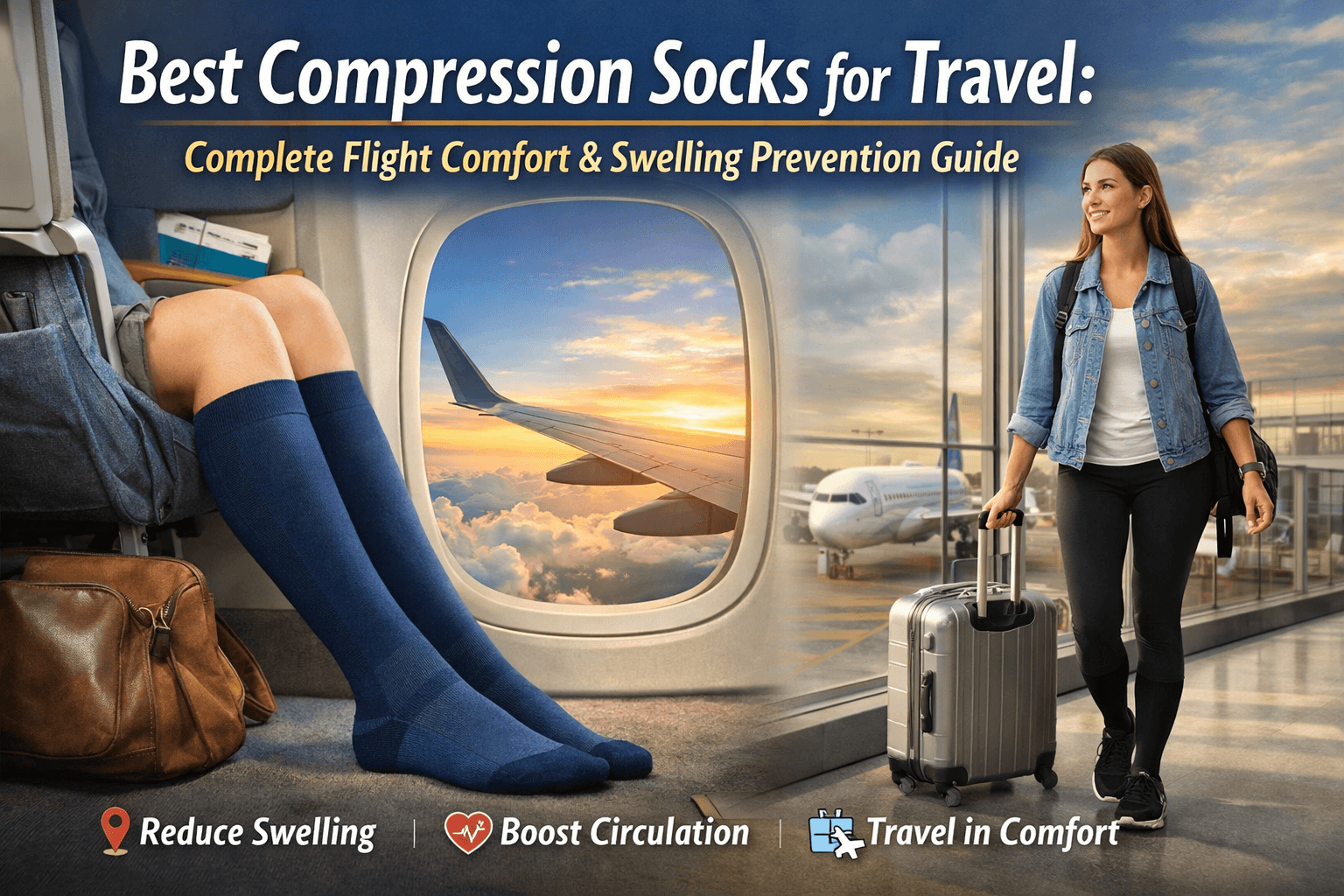
Swollen ankles, pins-and-needles legs, stepping off the plane feeling heavy and sluggish, if that sounds familiar, you’re not alone. Hours of sitting slows circulation and lets fluid pool around your feet and calves. The right compression socks for travel can change that experience entirely: less swelling, steadier energy, and a lower risk of flight-related circulation issues. This guide shows you exactly how to choose, fit, and use compression socks so you land ready to sexplore, not to recover.
Consider trying a properly fitted pair on your next trip; many travelers feel the difference after a single long-haul.
How Compression Socks Work on a Plane
Compression socks apply external pressure to the leg, with the firmest squeeze at the ankle that gradually decreases toward the knee (called graduated compression). This gentle gradient supports your veins’ one-way valves so blood returns to the heart instead of pooling in the lower legs. Better venous return means less fluid buildup and less discomfort. It’s the same principle sports med and vascular clinicians rely on, adapted for travelers who sit still for hours.
Think of them as a low-effort upgrade to every seat in economy: quiet, invisible, and working the entire flight while you relax, read, or nap.
The Right Compression Level for Travel
Compression strength is measured in millimeters of mercury (mmHg). Choose a level that matches your trip length and your personal risk factors:
- 10–15 mmHg: Light support for short flights and everyday standing. Comfortable for first-time users who mainly want to curb mild puffiness.
- 15–20 mmHg: Sweet spot for most travelers, especially on flights 3–8 hours. Noticeably reduces swelling without feeling “medical.”
- 20–30 mmHg: Firmer support often favored on ultra-long-haul flights, for recovery after strenuous activity, or when advised by a clinician for varicose veins or higher clot risk.
If you’re pregnant, recently postpartum, have a history of blood clots, or you’re combining multiple risk factors (long-haul + hormonal birth control, for example), talk with your healthcare provider about the right level before you fly. You’ll still want a sock that’s comfortable enough to keep on for the whole journey.
Fit Comes First: How to measure and size compression socks correctly
Perfect compression starts with accurate measurements. Set aside five minutes and a soft measuring tape.
- Measure the narrowest point of your ankle, just above the ankle bone.
- Measure the widest part of your calf.
- Measure leg length from the floor to the bend of your knee (for knee-highs).
- Take measurements in the morning if you tend to swell during the day. If you’re already swollen, use those measurements and size up only if the brand instructs.
Match your numbers to each brand’s size chart; don’t guess based on shoe size alone. If your calf measurement is near the top of a range or you have athletic/wide calves, consider a wide-calf fit to avoid digging or roll-down.
You might explore open-toe styles if you prefer sandals at your destination or have a sensitive toe box. Thigh-high stockings are rarely necessary for healthy travelers; knee-highs are usually ideal for flying.
The 60‑Second Fit Check
- The top band sits two finger-widths below the knee crease and lies flat with no folding or rolling or tourniquet effect.
- The heel cup aligns with your heel; no twisting.
- Fabric is smooth with no bunching at the ankle.
- After 10 minutes of standing or walking, you feel gentle support but no numbness, tingling, or cold toes. If you do, remove them and reassess sizing.
If you’re between sizes, many readers choose the larger size for comfort on long flights.
Travel-Friendly Features That Matter
Not all compression socks are created equal. Prioritize features that improve comfort and performance in a cabin environment.
- Graduated compression: Ensures the pressure decreases up the leg, supporting upward blood flow. Uniform “support socks” are fine for mild fatigue but aren’t as effective for flight swelling.
- Breathable, quick-dry fabrics: Nylon and polyester blends manage moisture; a touch of spandex/elastane delivers stretch and rebound. In cold cabins or winter travel, a Merino blend adds temperature regulation and odor resistance without bulk.
- Smooth, flat toe seams: Prevent hot spots when you’re walking concourses or wearing snug shoes.
- Soft, wide top band: Stays put without biting into skin, so critical for comfort over many hours.
- Thin-but-durable knit: Slim enough to fit under dress shoes or sneakers; reinforced heel/toe for longevity.
- Latex-free options: Helpful if you have sensitivities. Check labels if you’re prone to skin reactions.
Copper-infused yarns and elaborate cushioning patterns are optional. Prioritize fit, fabric, and proper compression level over marketing claims. If a sock is impossible to get on or feels abrasive after an hour, it’s the wrong sock for travel regardless of buzzwords.
How and When to Wear Compression Socks on Travel Days
- Put them on at home before you leave, when legs are dry and cool. Avoid lotion immediately before donning; it can make fabric slip and fold.
- Keep them on through security and the flight. TSA doesn’t require removal.
- During the flight, stand and walk the aisle every 60–90 minutes if you’re able. In your seat, do ankle circles and calf pumps; compression augments these mini-movements.
- Stay hydrated and limit alcohol, which can worsen dehydration and swelling.
- After landing, you can keep wearing them for a few more hours if you tend to swell or take them off once you’re upright and moving.
If you’ll be sleeping horizontally at your destination, remove them for bedtime unless a clinician advises otherwise. Compression is designed for upright or seated periods, not overnight sleep in bed.
Who should use compression socks for travel
Most healthy travelers tolerate 15–20 mmHg knee-high socks very well. They’re especially helpful if you:
- Fly more than 3 hours, particularly in economy.
- Have a history of ankle swelling, varicose veins, or achy legs after sitting.
- Are pregnant or postpartum (confirm your compression level with your provider).
- Are taking a once-in-a-lifetime long-haul and want to minimize fatigue on arrival.
Avoid compression socks or get medical guidance first, if you have peripheral artery disease (PAD), advanced or poorly controlled diabetes with neuropathy or open foot wounds, severe skin disease, or acute leg infection. If you feel pain, numbness, or see skin color changes while wearing them, remove them and reassess size/fit.
Best compression socks for different travel types
Use these scenarios to narrow your pick quickly. When in doubt, test a pair on a normal day before your trip.
- Ultra-long-haul flyer (8–16 hours): Knee-high, graduated 15–20 mmHg in a thin, breathable knit. If you have varicose veins or a clinician’s advice, consider 20–30 mmHg. Dark, dress-sock styling works across business and casual outfits.
- Short city hops and commuter flights: Light 10–15 mmHg or targeted ankle/arch compression for freshness without a “squeezed” feel.
- Warm-climate travel: Ultralight synthetic mesh panels to vent heat; moisture-wicking yarns to reduce clamminess.
- Cold cabins or winter trips: Merino-blend knee-highs for warmth plus odor control; still choose 15–20 mmHg for balanced support.
- Wide calves/athletic build: Wide-calf patterns with stretch through the upper cuff; confirm calf circumference range on size chart.
- Pregnancy/postpartum: 15–20 mmHg knee-highs with a gentle top band. For persistent swelling or varicosities, discuss 20–30 mmHg with your provider.
- Destination race or hiking trip: 20–30 mmHg for post-activity recovery and long flights home; thin knit to fit inside trainers without crowding toes.
- Sensitive skin: Latex-free, seamless toe, soft cuff; consider Merino blends if you want natural fibers with thermoregulation.
Many readers choose a “travel drawer” setup: one thin black pair for business trips and one breathable pair for hot-weather holidays.
Mistakes to avoid when using compression socks
- Guessing size from shoe size alone. Always measure ankle and calf.
- Wearing two pairs at once. More pressure isn’t better; it’s risky.
- Letting the top band roll. That creates a tourniquet effect, so smooth it out or size up.
- Slathering lotion before donning. Put socks on dry skin; moisturize after you remove them.
- Keeping them for years. Elastic fatigues. Replace travel pairs every 6–12 months when you notice slipping, bagging, or easier stretch.
- Ignoring discomfort. Numbness, cool toes, or tingling means the fit or level is off.
If you’re new to compression, consider trialing them for a workday at your desk. It’s a low-stakes way to dial in size before a long-haul.
How to care for compression socks properly
Extend performance with simple care habits:
- Turn inside out; machine-wash cold on delicate in a mesh bag.
- Skip fabric softeners (they coat fibers and reduce elasticity).
- Air-dry flat or hang; avoid high heat.
- Rotate between two pairs on multi-leg trips so each pair fully rebounds.
- Do the “snap test” monthly: stretch the cuff and release. A crisp rebound means the compression is still reliable.
Packing tip: Roll from the toe up to protect the cuff. Tuck rolled pairs into shoes to save space and keep shape.
Conclusion
For most travelers, knee-high, graduated compression socks in the 15–20 mmHg range provide the best balance of comfort and support on flights longer than three hours. Measure ankle and calf precisely, choose a breathable fabric that fits your climate and shoes, and check that the top band sits flat below the knee without digging. Put them on at home, keep moving periodically in-flight, hydrate, and replace pairs when elasticity fades. If you’re pregnant, have varicose veins, or other risk factors, discuss whether 20–30 mmHg makes sense for you. Avoid compression if you have PAD, severe neuropathy, or open foot wounds unless cleared by a clinician.
FAQs about compression socks for flights
How tight is “right”?
Snug and supportive, not painful. You should be able to wiggle toes freely and forget you’re wearing them after 10–15 minutes.
Can I sleep in them on the plane?
Yes, airplane sleep is still in a seated position. Remove for bed at your destination unless instructed otherwise.
Do men and women need different socks?
Style varies, but fit is based on measurements, not gender. Use the chart that matches your numbers.
Will security make me remove them?
No. They’re like regular socks at screening.
Are calf sleeves enough?
Sleeves help with muscle support but don’t manage foot/ankle swelling as well. For flights, full knee-high socks are usually best.